
Four pillars upholding the light of the prophets;
Though made by none less than a conqueror-king,
Alexander’s tower shone not half as long,
Neither did it feel tremour of an Angel’s song.
Long-standing dark, the last cry for Repentance,
Blazes high among stars, overpow’ring the Dawn.
Look not to the sun but replenish your vows,
Make ready your heart for the Angels’ King.
Feeding and growing the light silent listens,
Holding its breath in anticipation,
And melting wax falling and slipping down, glistens,
Ensuring the bridge from the Fire to the World –
. . . the Christ is coming soon.
Author: Knight of the White Rose
The White Rose represents Courage, Purity and Spiritual Love.
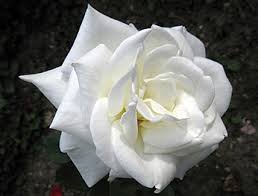
Eyes of the Rose
We’ve looked before in the darkness,
And daylight – they were the same;
In prayer or conversation,
Or silence – watching the rain,
The sunshine, clouds of evening,
A soul beside me dwelt,
In cold and snow, tiredness, pain,
In all moments I felt,
The glance of a thorn, and breath of a Rose.
I looked and loved what lived beyond,
Within, inseparably from the soft
And blooming beauty of Divinity’s shadow,
A soul far closer in her nature to angels
Than that of my own. A jewel, a treasure,
Sanctuary and tabernacle of God and new life,
Of others immortal, eternally being.
The surface is fair, both lovely, mysterious
Beneath lies the true Beauty, revealed with care;
Through the eyes of the Rose with peaceful love,
I saw there imprinted the Image of God.
The Why
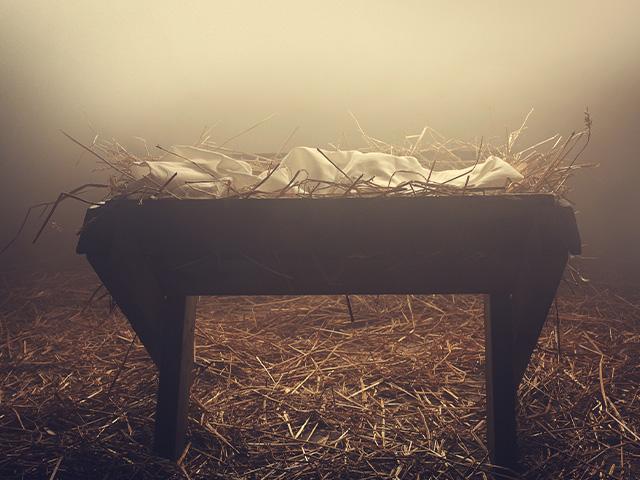
Christmas relentlessly approaches; no faster than the clock permits, though we all know that the perceived speed of the clock varies relative to our activities. Thus for me it seems to be coming up too quickly with too little preparation.
The most significant ‘preparedness’ one ought to have is that of the soul – being ready to receive the Christ into ones heart, full of nothing for Him there but love. What pull us away from that sometimes are the external things: Decorating, writing cards, running through lists of names and hoping that we didn’t forget to acquire gifts for any of them.
Some of us worry not about preparing for Christ and others, so much as wishing to slow down the clock and speed up our actions so as to do the Everything we desire to complete. There can be a temptation to boil everything down to the ‘what I want to do’, and although externally we could seem to be accomplishing things for others, it turns to having the focus on ourselves.
It is good to ask ‘Why’. Why am I doing this? Why do I want to do this? Because not only the actions themselves but also the intentions are required for a thing to be spiritually meritorious or sinful, we should know ‘Why’.
Why do we want to perfect ourselves and give that a particular focus during Advent? For the sake of reaching a personal goal, or because it is a good thing which has eternal merit? Because it is pleasing to God?
Why do we prepare for Christmas with all these physical things – decorations, gifts, etc?
To our society in general Christmas is nothing more than a party and marketing racket which begins in mid-September and by the time it concludes with the New Year, everyone is sick of it. For Christians, it is a celebration of the Birth of the Redeemer which begins the day the worldly party ends.
Are we trying to do so many things because it is custom, or because we want to celebrate our Saviour’s entry into the world with these things as well as having a soul and heart prepared?
We should take the words of Bishop Sheen to heart:
“How to find Christmas peace in a world of unrest? You can not find peace on the outside but you can find peace on the inside by letting God do to your soul what Mary let Him do to her body, namely let Christ be formed in you.
Is God Necessarily One?
St. Thomas Aquinas’ arguments for the ‘Oneness’ of God are several.
The first says that if there were many gods, they would be called ‘god’ either univocally or equivocally. If equivocally, then he says that “this is not relevant to our topic.” (Short and simple.)
If univocally, then they must all be the same in genus or species, but he showed that God can be neither genus nor species, and therefore multiple gods are impossible.
The second argument is fairly straightforward – It is impossible for one thing to be multiple things.
“If an essence is individuated by itself, it cannot pertain to many.“
Because God’s essence is His existence, the divine essence is individuated by itself. The following conclusion is the same as the first. God can not be more than one.
I won’t go into the third due to general laziness and a lack of sufficient cause.
While giving one of my brothers (who is about a decade younger than I) a random quiz on what he is studying in his Religion books, I was given a response to the question: Why can there be only one God?
His answer was remarkably close to that which I gave my grandmother in reply to the same question about ten years ago: “There can be only one God because everything made works together with everything else in the world.”
His argument is that because everything he has observed about the natural world acts and reacts so perfectly together, it seems unreasonable to think that there could be more than one Mind and Designer behind it all. This, from a ten year old who is quite diligent in his reading on natural science, particularly zoology. Rather than strengthening the claim that some have made that knowledge of the world and of God are incompatible, his studies are showing him more and more of the Beauty and Wisdom of his Creator.
When I answered my grandmother ten years ago, I added that if there were many gods then either they would all be equal and thus no Supreme Being.
(It was simple math. Many things equal to one another are all equal.)
My brother this morning, with a little help, got around to that reasoning as well, and also found that if there were many gods, and one of them was ‘higher’ than the rest, that he would be supreme and thus God (according to the definition of God as ‘Supreme Being’).
It seems that anyone can, without having to understand genus or species, form or essence, discover the ‘Oneness’ of Divinity, and I for one find myself relieved to know that it is not necessary to have the intellectual capability that St. Thomas had. If that were so, I for one would be quite lost.
Makes me wonder why most of the world before Christ and for a long time afterwards was pagan; full of people who worshiped multiple gods. Perhaps because there are innumerable spiritual beings who are not in compliance with the Will of God. Demons can (and do) mimic the Truth, appealing to fear and concupiscence, showing the good as something rightfully ones own rather than a gift, displaying the false advertisement of Divinity to men as though we could become gods.
Hopefully more thoughts (I mean actual thoughts) on that later . . .

Ad Venit III
The fire now multiplied forms a trinity;
One light, one flaming substance,
Mutes the irate winds that would flare,
To smother Hope and cease Rejoicing.
Angel minds serenely voicing,
Of the new Life within a maiden,
Dwell about her in wonder, guarding, waiting,
For Love Incarnate alone to see.
Ad Venit II
Red and dim, a spark joins the first flame,
Silent and smouldering through voiceless winds,
A King is coming, though Caesar should reign,
A new Light ignites, casting to the skies,
The second blow of hope, now glimm’ring like eyes.
Two beacons stand, coloured for Repentance,
Two pillars now remain unlit, deep in thought they stand.
Wait, wait, the world has lived,
O’er Advent millennia long,
Weeping for joy that it shall at last,
Endure the Angels’ song.
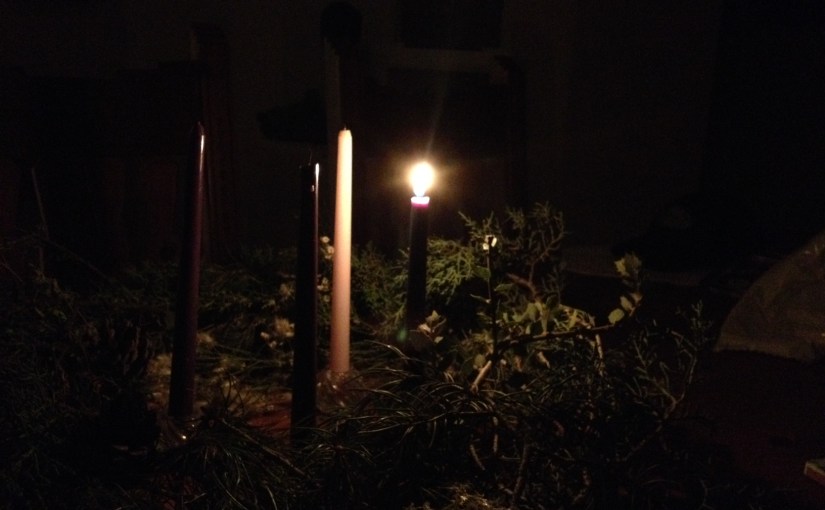
Ad Venit
Darkness has gathered for thousands of years,
Gloom and death’s assembly summoning fears,
Of sins extinguishing the hope of God,
Crimes sharply demanding blood,
Nations driven together and temples overthrown,
Demon-gods, lashed and chained,
Burning forever on their throne.
A flaming sword, a pillar of fire,
Guarding the Tree of Life, leading God’s Nation,
Expelling and Summoning, power of the Same,
Inextinguishable Light shining o’er the darkness. . .
. . . We recall with one candle aflame.

A Quote
Delving two years back into my Google+ archives I found this, and would like to share it:
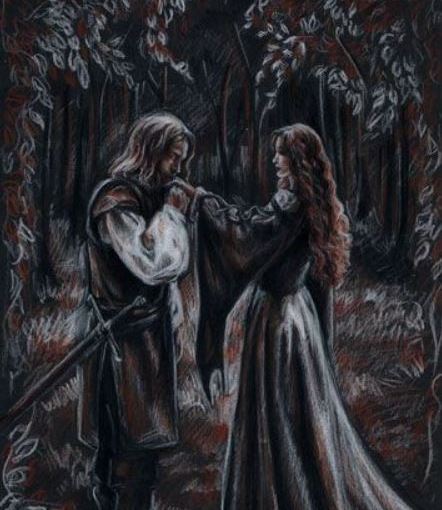
“We should have a clear notion of what chivalry is. It is a form of preferential treatment that men once accorded to women generations ago, inspired by the sense that there was something special about women, that they deserve added respect, and that not doing so was uncouth, cowardly and essentially despicable.”
~Pier Massimo Forni
It’s not quite an adequate summary, and I will add that such ‘treatment’ involves all actions of Mind as well as Body, but I saved it nonetheless.
End of a Promise?
When the King should summon me,
To step above this wasted world,
Would you then Love, willingly,
Surrender my heart and let me go?
When the link of our vows be unchained,
And I, your Treasure, through a lifetime guarded,
Long to abandon you for Love,
of God and you, to love you more,
Then might be our sacrament’s test:
‘Do you truly love me?
I love you enough to leave you.
Will you let me go?

To See Over the Mountains
“In every friendship hearts grow and entwine themselves together, so that the two hearts seem to make only one heart with only a common thought. That is why separation is so painful; it is not so much two hearts separating, but one being torn asunder.”
Bishop Fulton J. Sheen
It is always painful in some measure to leave a person you love. I’ve been repeatedly reminded of this fact today, and in reflecting on the words of this holy man, was reminded of something that I was told by an instructor in August 2018 while out in the mountains.
“Think of how Mary felt on Calvary, how much she was hurt. She knows more than anyone what pain separation from a loved one can be.”
There are times when it is impossible to understand why God directs or permits circumstances – at least in the more immediate sense. His Will is nothing but the good of each individual, the ultimate end for which He designed us. A temporary distancing and hurt can, if we so permit, be to guide us away from a permanent hell and closer to the resurrection.
He never takes away something permanently, we just have to be patient and trust Him.
. . . Usually easier to say than to act upon, isn’t it?
One can’t see what is beyond the mountain without first climbing it (or going around, but that’s a much longer journey). In some cases, one can literally see over the mountains while taking the first step upwards.
That’s what I saw over the mountains.
 The Knight of the White Rose - Conquest and Surrender of Two Hearts